Why Do Teenage Girls Love Horror Movies? A Therapist (Who Also Loves Them) Explains
Your anxious daughter just asked to watch something terrifying. Here’s why that’s a good sign.
By Shayna Barksdale, LCSW-S
Let me get something out of the way first: I’m not the therapist who’s going to tell you to turn it off.
I love horror movies. October is my favorite month of the year, and not because of the pumpkin stuff. I am the grown woman in the theater with the popcorn, waiting for the thing to come out of the closet. So when a mom sits in my office and says, half-worried, “she’s obsessed with scary movies, is that normal?” — I have to work a little to keep a straight face.
It’s normal. It’s more than normal. For a lot of girls, and especially the anxious ones, it’s doing something useful.
If you typed “why does my teenage daughter love horror movies” into your phone after she and three friends screamed through a movie in your living room last Friday, here’s the straight answer.

Horror is anxiety with an ending
Think about what anxiety actually feels like from the inside. Something bad is coming. You don’t know what. You don’t know when. Your body is braced for it all day, and the thing never shows up, so you never get to un-brace.
That’s Tuesday for an anxious girl. That’s the group chat, the test, the lunch table, the message she sent that hasn’t been answered yet.
Now think about what a horror movie is. Something bad is coming. You don’t know what. You don’t know when. Your body is braced —
and then it comes. It jumps out. Everyone screams. And ninety minutes later the lights come up, the girl on screen made it, and your daughter is on the couch, alive, eating the rest of the popcorn, laughing at her friend who screamed the loudest.
For once, the dread had a shape, a timer, and an ending. She got to feel the whole arc of fear and come out the other side. Anxious girls almost never get that in real life. They get the buildup with no payoff, over and over.
A horror movie is two hours of practice at being scared and being fine.
She’s not scared of the movie. She’s on the couch with her friends.
Here’s the part parents miss because they’re in the other room.
Watch how girls watch horror. Nobody’s watching alone in the dark with a serious face. They’re piled on the couch under one blanket, four of them, somebody’s got a pillow up to her eyes, somebody else is narrating (“don’t go in there, DON’T go in there”), and when the thing jumps out they grab each other and scream and then immediately laugh.
That’s not fear. That’s bonding with a jump scare attached.
Boys have had this forever — roller coasters, tackle football, jumping off the high thing at the lake. A safe way to be scared together and prove to each other you can take it. Horror movies are one of the few places girls get the same deal. Same adrenaline, same “we survived it,” and nobody ends up at urgent care.
It’s also why Stranger Things never went away. Strip out the monsters and it’s a show about a group of kids on bikes who figure out that the grown-ups can’t fix it and they’re going to have to do it themselves, together. Good versus evil, walkie-talkies, nobody gets left in the Upside Down. That’s not a horror fantasy. That’s the friend group every eleven-year-old girl is trying to build, with a demogorgon in it.
If your daughter’s friend group has a standing scary-movie night, that’s a friend group that’s working. Bring snacks and stay out of the room.
The girl is the one who survives
There’s a term for this in horror: the final girl. She’s the one who’s still standing at the end. She figured it out, she fought back, and she walked out of the house.
Think about how rare that is. In most of what a teenage girl watches, she’s the girlfriend, the sidekick, the one who gets rescued. In horror, she’s the one who lives — not because she was the prettiest or the nicest, but because she paid attention, trusted her gut, and kept going when she was terrified.
I’m not going to pretend every horror movie is a feminist text. Plenty of them are dumb, and some of them are dumb in ways I don’t love. But the through-line of the genre, from Halloween to Scream to the stuff your daughter’s watching right now, is a girl who is scared out of her mind and does the hard thing anyway.
That is, word for word, what we’re trying to teach in my office. Being brave doesn’t mean not being scared. It means being scared and doing it anyway. Your daughter has watched that lesson forty times. She just calls it a movie.
Horror is secretly full of moms
Here’s the part that’s for you, not her.
Start with The Exorcist. Everybody remembers it for the head spinning and the pea soup. Watch it again as a mother and you’ll see a completely different movie. It’s about a mom whose twelve-year-old changes overnight into someone she doesn’t recognize. The girl says things that would’ve been unthinkable a month ago. She’s cruel, she’s scary, she’s not her. And the mom drags her to every doctor in the city, and every one of them runs the tests and shrugs, and she ends up begging a stranger to help her because she is out of ideas and she is not giving up on her kid.
I’ve sat across from that mom. Minus the pea soup. A girl hits twelve or thirteen and a mother comes in saying “I don’t know who this is. Where did my daughter go?” And the answer, most of the time, is the same as the movie: she’s still in there. She was in there the whole time. What’s on the surface is not the whole girl.
Fifty years later it’s still the scariest film ever made, and I think that’s why. It’s not the demon. It’s the mom.
This month, two more showed up, and they’re both mom stories too.
Carrie came back October 7 as a new series on Prime Video. You probably know the original: the lonely girl nobody sits with, the prom, the bucket. Your daughter may not know it at all. This version is set right now, which means the girls tormenting Carrie have phones, and what happens in the locker room doesn’t stay in the locker room.
And her mom is more complicated this time. She’s not just the monster in the closet. She loves her daughter. She’s also so terrified of the world that her love turns into a locked door. Which puts a question at the center of the story that every one of us has asked at 2 a.m.: how do I protect her from a world this mean, without smothering her in the process?
The girl at the center is still the girl who gets left out, laughed at, and pushed until she breaks. Every middle schooler knows that girl. A lot of them have been her for a week or two. That’s the conversation to have after an episode: not “what would you do if you had powers,” but “has anyone at your school ever been treated like that? What did people do?”
Then on October 15, Peacock starts Crystal Lake, the prequel to Friday the 13th. Here’s the thing a lot of people forget: in the first Friday the 13th, the killer isn’t Jason. It’s his mom. This series is her story, and it starts with a mother grieving her boy. The working title while they filmed it was literally Mama’s Boy.
I’m not going to tell you Pamela Voorhees is a role model. She is a cautionary tale with a machete. But the engine of her whole story is a mother who loved her kid so much, and hurt so badly, that it became the only thing she was. Most of us will never get anywhere near that line. We all know what it feels like to lean toward it.
Three mothers. One who won’t give up. One who’s so scared of the world she can’t let her daughter into it. One who loved her kid so much it swallowed her. That’s not a horror lineup. That’s a Tuesday night moms’ group.
Why they’re all talking about Obsession
If you’ve got a teenager in the house, you’ve heard about Obsession by now. It’s the one everybody is, well, obsessed with this year, and it’s a good example of what I mean when I say horror sneaks the real stuff in.
No spoilers, but here’s the setup: a guy has a crush on a girl who doesn’t feel the same way, and he gets a wish. He wishes for her to love him. He gets exactly what he asked for.
That’s the whole horror. Not a monster. Getting what you thought you wanted.
And it asks the question every fourteen-year-old is already secretly asking: what’s the difference between someone wanting you and someone actually loving you? What does it look like when a person wants to own you instead of know you? And is being wanted that badly actually the dream, or is it a trap with better lighting?
Those are the exact questions a girl needs answered before she’s in her first real relationship, and she is not going to ask you over dinner. But she’ll talk about a movie. So if she’s seen it, ask her what she thought of the guy. Ask her at what point it stopped being romantic. Ask her if she’s ever had someone “like” her in a way that felt like too much. Then stop talking and listen. You just got a conversation about consent, control, and what real love looks like, and nobody had to say the word “boundaries.”
She’s practicing “and then what?”
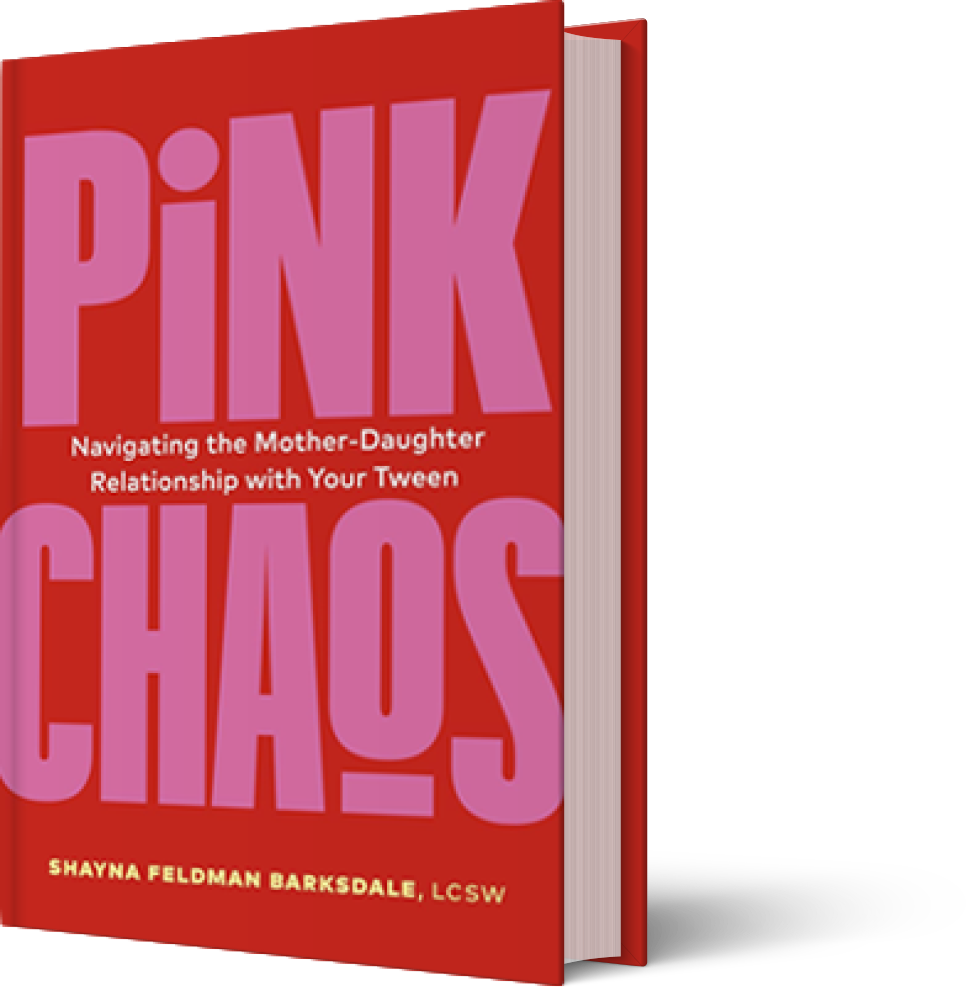
In my book Pink Chaos, one of the tools in Chapter 5 is called “and then what?” — I call it fast-forwarding the movie. When a girl is spiraling (“what if I fail the test”), you don’t argue with the fear. You walk it forward. And then what? “I’d get a bad grade.” And then what? “I’d have to tell you.” And then what? “You’d be mad.” And then what? “I’d… study more next time, I guess.” And then what? “…it’d be fine.”
Anxiety lives in the first frame. It never lets you fast-forward to the part where it’s fine.
A horror movie forces the fast-forward. You have to sit through the whole thing. You can’t leave the girl in the basement. You watch the worst possible version of “and then what?” play all the way out, and then you get up and get a Sonic run. Every single time, your daughter’s brain is quietly learning that the worst part has an end.
I’m not saying Scream is therapy. I’m saying the wiring is the same, and she found it on her own.
Okay, but how scary is too scary?
This is the real question under “is it normal,” so let’s answer it.
Watch her, not the rating. Some twelve-year-olds can handle a slasher and sleep fine. Some fifteen-year-olds get wrecked by a haunted-house trailer. You know your girl. The rating tells you about the movie; it doesn’t tell you about her.
Watch episode one yourself first. Especially with the new series this month. Carrie and Crystal Lake were both made for grown-ups, and a series is eight hours, not ninety minutes. If you’re thinking about it for your eighth grader, watch the first episode on your own some night. You’ll know by the end of it. And if it’s a yes, now you’ve seen it too, which means you’ve got something to talk about in the car.
The tell is the next day, not the night of. Screaming during the movie, sleeping with the hall light on that night, texting friends “I’m never sleeping again” — that’s the fun part. That’s what she signed up for. What you’re watching for is the next day, and the day after: she can’t go upstairs alone, she’s checking locks, she’s not sleeping three nights later, she’s more anxious in daylight. That’s the movie outlasting its welcome.
Some content isn’t about scary. A jump scare is one thing. A story built on sexual violence, or on a girl being tortured, is a different thing, and “she’s mature for her age” isn’t the right filter for it. That’s a judgment call you’re allowed to make, and you’re allowed to say no without a debate.
Ask which kind she likes. Horror is not one thing. There’s slashers, ghosts, creature movies, the psychological ones like Obsession, the found-footage stuff, the funny-scary ones, the eighties-throwback stuff like Stranger Things. Ask her what she’s into and why. Ask her which scenes actually got her and which ones were “kind of dumb.” You’ll learn more about what scares your daughter in real life from that conversation than from any worksheet, because she’ll tell you sideways what she’d never tell you straight.
If you’re using the anxiety thermometer from the book (0 to 5 for younger girls, 0 to 10 for older ones — how hot is it right now?), a horror movie is a great time to try it. “Where were you when the doll turned its head?” “Like an 8.” “Where are you now?” “…3.” Look at that. It came down. On its own. That’s the whole lesson, and she just taught it to herself.
And if she’s the one who won’t watch
Some girls hate horror. Completely. Leaves the room, hands over ears, “why would anyone do this to themselves.”
That’s fine too. Not everybody wants to go on the roller coaster, and not wanting to be scared for fun isn’t a sign of anything. Where I’d pay attention is if she used to be fine with it and now can’t go near it, or if the not-watching is part of a bigger pattern of avoiding anything that gets her heart rate up. Then it’s not about the movie.
When it’s more than a scary-movie phase
Most of this is a girl having fun with her friends in the month the whole country agrees to be spooky. Some of it isn’t. Worth a conversation with someone if:
- The fear isn’t staying in the movie. She’s more anxious in daylight, at school, in the car, and it isn’t clearing up.
- Sleep has been a mess for weeks, not a night.
- She’s using scary stuff to feel anything — she seems flat the rest of the time and only lights up for the intense stuff.
- She says something that scares you. Trust that. You know her.
We see girls 8 to 25 right here in South Austin, in person and online, and we work with the parents too. Anxiety is most of what walks through our door, and we’re good at it. Tell us about your girl and we’ll help you figure out the right fit.
One more thing
The “and then what?” tool and the anxiety thermometer both come from Pink Chaos: Navigating the Mother-Daughter Relationship with Your Tween. So does most of what I said about the moms up there — the whole book is about the mother who’s looking at her twelve-year-old thinking where did my daughter go? Every chapter ends with a section called “Keys to Unlocking Girl World” — the actual scripts, so you know what to say instead of just what to think. It’s the kind of thing you can read in the pickup line.
Now go watch something scary with her. Let her pick. Scream when she screams. You’ll both sleep fine.
Free download: our Stress & Girls handouts — one for parents, one for your girl. No email required.
Ready to talk to someone? Tell us about your girl and we’ll help you figure out the right fit.
We have two more spots in our 4th & 5th grade Glow Girl fall group. Get more info here.
Austin Therapy for Girls · 8701 Menchaca Rd · 512-981-LCSW