

“I Hate You.” … “Can We Go To Starbucks?”
4:10. She walks in. You say, “Hey — how was your day?”
4:12. You get a look, an eye roll, and an “I hate you” thrown at the floor. She drops her backpack where it lands and heads straight for her room.
4:17. She’s in the kitchen in different pants, holding her phone, asking if you can go to Starbucks and swing by Target after.
Same girl. Same afternoon. Five minutes apart.
You’re standing there about to lose it. What happened in the last five minutes? Are you being Punk’d? Is Ashton Kutcher about to walk out of the pantry?
She doesn’t hate you. I want to say that part first, because if you typed “why does my tween daughter hate me” into your phone at eleven o’clock last night, you deserve a straight answer before you scroll.
You’re both on the roller coaster
I dedicated my book to my mother, and the dedication is four words long: thanks for riding the roller coaster.
My mom is Kappie Bliss. She’s a therapist too — she was my school counselor at my own high school, which is a whole other blog post — and she’s in every chapter of that book. The sidebars called “Sprinkles of Bliss” are hers. Fifty years of watching mothers and daughters, dropped in beside my thirty.
Here’s what I don’t usually put in writing. Two years ago, when the book came out, I was doing readings and signings, the most rewarding stretch of my whole career, and I was not fully there for a minute of it. My mom was in radiation for stage 4 lung cancer. I’d stand in front of a room full of women, mean every word I said, and worry the entire time. I was promoting a book about mothers and daughters, written with my mother, while sitting in the daughter seat, scared.
Two years later, thanks to immunotherapy, the scans keep coming back with no new spots. In our family, that’s the good news, and we’ll take it.
So when I say the roller coaster doesn’t stop at thirteen, I mean it doesn’t stop at twenty-five either, or at fifty, or when you’re the one driving her to the appointments.
That’s what these years are. And the part nobody tells you is that you’re not down on the ground holding her jacket and watching the ride. You’re strapped into the seat next to her.
Look at what’s changing for her. A body that’s rearranging itself on no schedule she agreed to. A brain in the middle of the biggest renovation it will ever undergo. And middle school — eight teachers instead of one, four minutes to get across a building, a locker she can’t open while people watch, and a lunch table that can be fine on Monday and a problem on Tuesday for reasons nobody will explain to her. Middle school is hard. I’ve been doing this for thirty years, and I have never once had a person sit across from me and tell me middle school was a great time. Not a girl, not a mom, not a grandmother. The very best anybody offers is “I survived seventh grade.” That’s it. That’s the review.
And it’s harder now than it was for us, for one reason: it doesn’t end when she gets in the car. It comes home in her pocket.
Now look at what’s changing for you. The kid who used to tell you everything has started closing a door. Your job description changed without a meeting. A lot of us are going through our own physical and emotional changes at the same time, on our own no-schedule-we-agreed-to. And your middle school — the cafeteria, the girl who stopped talking to you in seventh grade — comes right back up the first time she says nobody sat with her.
Two people in an enormous transition, in the same kitchen, at 4:12 in the afternoon.
There’s a parenting book from the nineties called Get Out of My Life, but First Could You Drive Me and Cheryl to the Mall? The title is the entire thing. Thirty years later the mall is a Starbucks drive-thru and Cheryl is a group chat, but the girl on that ride is exactly the same.
Five minutes is not a sign she’s manipulating you. It isn’t a sign she didn’t mean it, either. Both things were true at once — she was done with everyone, and she still wanted her drink — and she doesn’t yet have a way to hold two true things at the same time without one of them falling out of her mouth.
That’s the drop. It’s loud, it’s short, and then the car levels out.
Which is also why five minutes in your kitchen on a Tuesday afternoon matter more than they feel like they do.
Why you get the worst of it
Here’s what I hear from moms in my office every single week: she’s fine at school. Her teachers love her. She’s an angel at her friend’s house. And then she walks in my door.
Yes. That’s how it works.
She holds herself together all day. Every class, every hallway, every text she reads four times before she answers. By the time she gets in your car she is running on nothing, and you’re the one person she’s certain will still be there in five minutes.
You’re not getting the worst of her because you’re the worst. You’re getting it because you’re the safest. That’s not a broken relationship. That’s the proof it’s holding.
What she’s actually doing
Her job right now — the actual work of being eleven, twelve, thirteen — is figuring out who she is when she isn’t being your daughter.
That’s a big job and she has almost no words for it. So it comes out as an eye roll. Or a closed door. Or “you don’t understand.” Or “I hate you,” which is usually closer to I need some room and I don’t know how to ask for it.
And then the other half of her, the half that’s still a kid, wants a snack, a ride, and her mom.
Both are her. Nobody’s faking.
Four tools for the next time it happens
These come from the “Keys to Unlocking Girl World” sections at the end of each chapter in my book. They’re the same ones my therapists use in our office every day.
1. Validate before you do anything else
Validation is not agreement. That’s the part that trips up almost every caregiver I work with. Saying “I understand why you feel that way” is not saying “you were right to walk off on me like that.”
The version we teach comes from Emotion-Focused Family Therapy, and it has a shape: the feeling, plus three becauses.
“It makes sense that you’re this done right now. Maybe it’s because today was about nine hours long, because that group chat has been a mess all week, and because I asked you a question before you’d even put your backpack down.”
Three guesses. If all three miss, she’ll correct you — and now she’s talking, which was the entire goal. If one lands, you just told her that somebody in this house is paying attention.
If the judgy part of you shows up instead (“well, maybe if you’d studied”), that’s not a character flaw. In my experience that voice is almost always anxiety wearing a costume.
2. “I feel…” for the part you do need to say
You’re allowed to have a reaction to being looked at like that in your own kitchen. Just lead with you instead of her. Four parts:
- I feel — shut out. A little stung, honestly.
- When — a question gets an eye roll and a closed door.
- Because — I can’t tell if I did something, or if today was just awful, and I’d rather know.
- And I would like it if — on the way past me, I got four words. “Bad day. Need a minute.” That’s all.

Print the I-message handout — it’s the one we give to the mothers and daughters in our office.
It’s every therapist’s favorite tool and it can feel deeply cringe to say out loud. It also works, and it shows her how a person asks for what they need without dumping blame on someone.
Save it for later. Not at 4:12.
And later doesn’t have to be face to face. Send it as a text. Girls who can’t look at you yet will answer a text from one room away, and there’s nothing wrong with that — it gives her time to read it twice and think before she responds, which is exactly what you want. Take the opening in whatever form she can stand.
3. The Wonder Woman script — for the car
Every mom has a Wonder Woman moment in her. You know the one — you’d slept, you’d eaten, nobody had needed anything from you in twenty whole minutes, and your girl came to you with something hard and you handled it exactly right. It happens. I’ve watched it happen in my office.
This is the script for that version of you, so you can find her on the days you haven’t slept. It’s for the Starbucks run, when she finally tells you what actually happened. Three steps:
Connect with the emotion. “I get why that felt like a punch. They left you out.”
Meet the need underneath it. Every feeling is asking for something. Anger usually wants to be taken seriously. Sadness usually wants company. Anxiety usually wants reassurance. Offer that — a hug, or just “I’d be upset too” — before you offer anything else.
Then, and only then, problem-solve. Four questions:
- What do you want to do about this?
- What part of this can you control?
- What could you do for yourself that might help?
- How can I support you?
That third step is where most of us start. Starting there is why it goes badly.
And you do not have to be Lynda Carter spinning around in the driveway to pull this off. You just practice it, badly, on a Tuesday, and it gets easier.
4. And one for tomorrow at 4:10: learn her algorithm
Let’s go back to where this started. How was your day?
There’s nothing wrong with the question. But it’s a wide-open door, she’s exhausted, and it asks her to summarize seven hours of social weather in one sentence while she’s still holding her backpack. Most girls answer “fine.” The ones running on empty answer with an eye roll.
So swap it for something with edges. In our office we use Rose, Thorn, and Bud with the elementary girls — one good thing, one hard thing, one thing you’re looking forward to. For middle school we use Happies and Crappies, which gets a laugh, which is the point. Everybody at the table goes, including you. Some nights it takes ninety seconds. Some nights you hear about something you’d never have heard about otherwise.
Underneath that is the longer project, which I call learning your daughter’s algorithm. Companies spend absurd amounts of money figuring out exactly what your girl likes so they can keep her on the app. You can do the same thing, for free, with better intentions.
What is she into right now? What song is she playing on repeat? What trend has her attention? What does she daydream about? Who does she admire? What’s getting a side-eye (besides you)?
Don’t sit her down and run the list — that’s an eye roll waiting to happen. Sprinkle them in, and mostly just listen for what she’s already telling you.
And return the favor. Tell her what you were into at her age, what you loved, what you were scared of in seventh grade. She needs the reminder that you’re an actual person, not just the one asking about homework.
And here’s the part that matters most
You do not have to do any of this perfectly. If you pull one of these off 30 percent of the time, you’re golden. This isn’t a performance review. It’s a relationship, and relationships get repaired constantly — that’s not a sign one is failing, it’s the thing that makes one real.
What makes it worse
- Lecturing at peak heat. Nothing goes in. You’re talking to a girl whose brain has left the building.
- Punishing the feeling instead of the behavior. She’s allowed to be furious. She’s not allowed to be cruel on her way out of the room. Those are different conversations.
- Making her earn her way back to you.
- Bringing the fight back up three days later at dinner, in front of her brother.
- “After everything I do for you.” I know. I do. It never lands the way we want it to.
When it’s more than regular tween stuff
Most of this is ordinary, exhausting, temporary. Some of it isn’t, and you’re allowed to want a second opinion.
Worth a conversation with someone if:
- It isn’t only at home. School, friends, practice — the flatness or the anger is following her everywhere.
- She’s dropped things she used to love and hasn’t picked up anything new.
- It’s been weeks, not afternoons.
- She says something that scares you. Trust that feeling. You know her.
Calling someone doesn’t mean something is broken. It means she’s allowed to have help, the same as she’d be allowed to have a tutor or a physical therapist.
We see girls 8 to 25 right here in South Austin, and we work with the parents too — because “we serve girls and the people who love them” isn’t a tagline, it’s the actual job.
One more thing
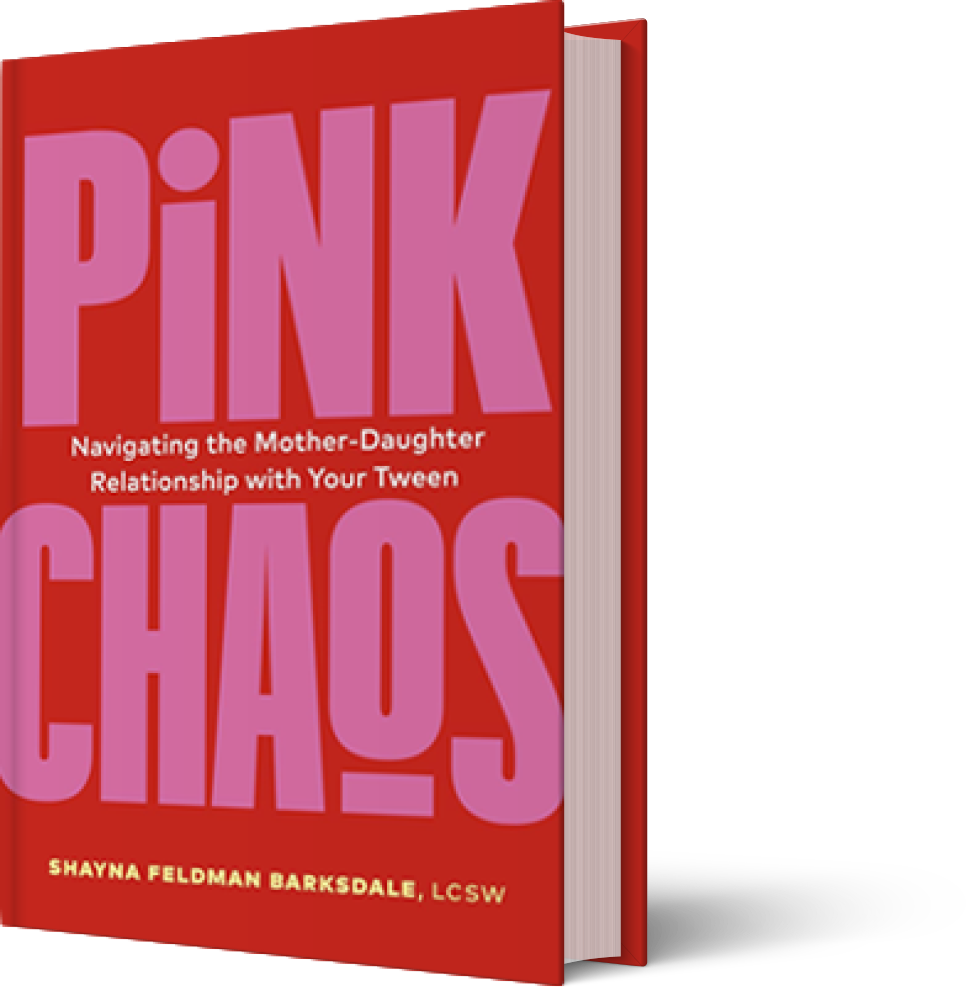
All four of those tools came out of Pink Chaos: Navigating the Mother-Daughter Relationship with Your Tween, which turns two years old this month. Every chapter ends with a “Keys to Unlocking Girl World” section — reflection prompts, therapy tools, and word-for-word conversation scripts, so you’re never left holding a good idea with no idea what to actually say. And every chapter has a “Sprinkles of Bliss” from my mom, which is fifty years of this work talking to thirty. There are seven chapters’ worth. This post has four.
To celebrate, and because National Daughters Day is September 25, the Kindle version is free September 23 through 27. Download it, read it in the pickup line, send it to a friend who’s in it right now. The paperback’s always there too, if you’re a hold-it-in-your-hands kind of reader.
Free on Amazon through Sunday, September 27.

Free download: our Stress & Girls handouts — one for parents, one for your girl. No email required.

Ready to talk to someone? Tell me about your girl and I’ll help you figure out the right fit.
Austin Therapy for Girls · 8701 Menchaca Rd · 512-981-LCSW