Periods, Shame, and Anxiety: What Girls Are Carrying at School
Why period product access matters for girls’ mental health this Period Action Day

Allie Evans, BSW intern
Picture this: you’re thirteen years old, sitting in class, and you realize you just got your period. Maybe you felt it happen, or you went to the bathroom between classes and saw the dreaded spot. Either way, you need a pad or a tampon, and you don’t have one.
Maybe you text your friends and hope someone brought one, or you walk to the nurse’s office and ask. Maybe you go up to a teacher and quietly explain why you need to leave class. Maybe there are period products somewhere in the school, but first you have to figure out where they are and who you have to ask.
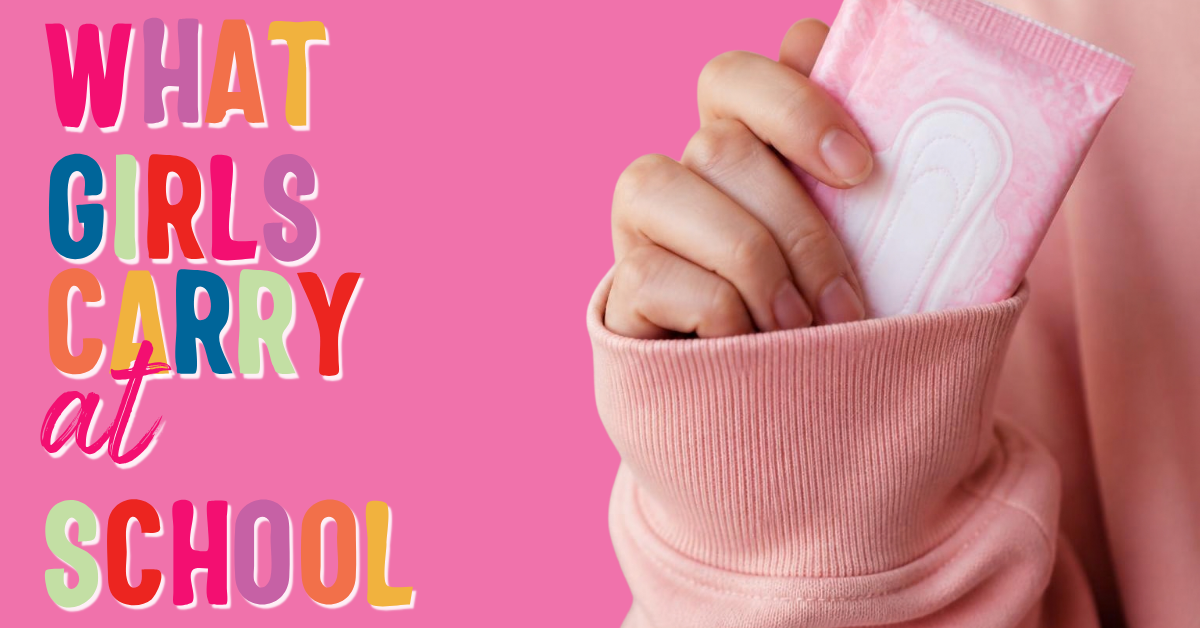
Somehow, you get one, and then comes the next challenge: getting it to the bathroom without anyone seeing it. So you shove the pad up the sleeve of your sweatshirt. Or into the waistband of your jeans. Or ball it up in your fist and pray nobody asks what you’re holding on your walk to the bathroom.
For something that roughly half the population experiences, we put an awful lot of effort into making sure nobody knows it’s happening.
October 10 is Period Action Day, a day dedicated to taking action against period poverty and stigma. Much of that conversation focuses on whether people can afford and access the period products they need. But at Austin Therapy for Girls, we think there’s another question worth asking:
What does not having easy access to those products feel like for a girl?
For a middle or high school student, not having a pad when she needs one isn’t just inconvenient. It can mean having to tell a teacher, asking a nurse, whispering to a friend, worrying about bleeding through her clothes, or missing class. And doing all of that while navigating a stage of life where feeling different from everyone else can feel like the end of the world.
Period product access is a complex issue, and for girls, it can become a mental health issue, too.
The Anxiety Isn’t Really About the Pad
For an adult, asking someone for a pad might not feel particularly significant. For a twelve-year-old girl who got her first period six months ago and is already highly aware of what everyone around her might be thinking about her body, it can feel exposing.
Suddenly, something her body does naturally has become something she needs to manage quietly, discreetly, and, most importantly, without anyone noticing.
Unfortunately, girls aren’t imagining the shame surrounding periods. The 2025 State of the Period study from PERIOD. and Thinx found that 62% of teens agree that society teaches people to be ashamed of their periods, while 59% say they personally feel affected by negative associations surrounding menstruation. That’s more than half of teens carrying some version of a shameful message about their periods.
Many girls enter middle school at an age where they can become more self-conscious of their bodies. They’re wondering whether they’re developing too quickly or not quickly enough. They’re worried someone noticed the pimple on their forehead. They’re comparing themselves to their friends or what they see on social media.
Then menstruation enters the scene. Something new begins to happen inside their bodies that they can’t fully control, while they simultaneously receive the message that nobody should be able to tell. Of course that can create anxiety!
When Access Becomes Anxiety
Period poverty is often discussed as a financial issue, but access is about more than whether a family can afford a box of pads. It’s also about whether a girl can walk into her school bathroom and simply find what she needs, without unnecessary barriers standing in the way.
When she can’t, getting a period product becomes a social interaction. She has to find someone to ask. She has to disclose something about her body that she may want to keep private, and that can affect more than a few uncomfortable minutes between classes.
Imagine trying to concentrate on an algebra test while wondering whether you’re bleeding through your pants. Or sitting through English class calculating exactly how many minutes are left until you can get to the bathroom. Or missing part of class because you’re walking across campus to the nurse’s office for something that could have been sitting in a dispenser ten feet away.
Having period products readily available in school bathrooms doesn’t eliminate every uncomfortable part of getting your period at school. But it does remove one completely unnecessary layer of anxiety. Suddenly, a girl doesn’t have to explain herself or find someone to ask, but instead, she can easily take what she needs in privacy.
Silence Around Periods Can Create Shame, Too
At Austin Therapy for Girls, one of our favorite topics discussed on our pink couches is how to combat shame. Shame thrives in silence, and the truth is no different when it comes to avoiding talking about periods.
The State of the Period report found that conversations about periods in schools are improving, but 37% of teens still report not having period conversations at school.
The more these conversations are avoided, girls begin to receive unspoken messages that periods are something to be ashamed or embarrassed about. Girls deserve accurate, age-appropriate information about what’s happening to their bodies before they’re sitting in a school bathroom stall wondering whether what’s happening to them is normal.
They also deserve to hear adults talk about menstruation without whispering, grimacing, joking about PMS, or treating a pad like contraband. Because girls are listening to the way we talk about their bodies long before we realize they’re listening.
Privacy Doesn’t Equal Shame
Ahead of Period Action Day, I’ve been thinking about that girl with the pad shoved up her sweatshirt sleeve.
Maybe you were her. I know I remember being her.
And the goal isn’t necessarily convincing the next generation of girls that they should proudly wave their pads through the hallway. Privacy is okay, wanting discretion is okay, but there’s a difference between privacy and shame.
A girl shouldn’t have to announce to the entire school that she got her period just to access a pad. She shouldn’t miss class because she couldn’t find one. And she shouldn’t feel like her body has done something shameful when it has done exactly what bodies do.
Shayna Barksdale, LCSW-S, founder
I Was Her Too, in Fifth Grade
When Allie showed me this draft, I knew that girl right away. I got my period in fifth grade. Fifth grade! Before my older sister did, which meant nobody in my house saw it coming, least of all me. It was a shock. I tell that story in almost every talk I give to girls, and every single time I watch a few of them in the room let their shoulders drop. Somebody else went through it. Somebody else survived it.
Here’s the thing: my fifth-grade story isn’t so unusual anymore.
Why Are Girls Getting Their Periods Earlier?
Girls today are starting their periods earlier than their moms and grandmas did. A 2024 Harvard study of more than 71,000 women found the average age of a first period dropped from 12.5 for women born in the 1950s and ’60s to 11.9 for women born in the early 2000s. The share of girls starting before age 11 nearly doubled, from about 1 in 12 to about 1 in 6.
Why? The honest answer is that researchers don’t fully know. They’re looking at a bunch of possible reasons, including chemicals in our environment and stress. Stress is the one I think about most. Research has linked stress and hard experiences in childhood to earlier periods. A 2025 Kaiser Permanente study of more than 52,000 kids found that girls who had been through more of those hard experiences were more likely to start their periods before 12.
Take a breath before you panic. An early period does not mean something bad happened to your daughter. Plenty of girls start early with nothing going on at all. (If you’re seeing signs of puberty before age 8, just loop in your pediatrician.)
What it does mean is that more girls are getting their periods at 9 and 10, which puts them in elementary school. There might not be a pad anywhere in the building. Nobody’s had the talk with her class yet. She’s the first of her friends, so there’s nobody to text. That’s the girl with the pad up her sleeve, only younger.
What Parents Can Do This Period Action Day
Here’s the part where I’m supposed to tell you to go donate a case of pads to your daughter’s school. And if you can, do it. Plenty of nurses’ offices around Austin run on donations, and a full dispenser in a bathroom is a small thing that takes one worry off a girl’s plate. Don’t skip the elementary school.
But the thing that changes the most for your daughter doesn’t happen at school. It happens in your kitchen.
Start earlier than you think you need to. If she’s 8, it’s not too early. Then keep talking about periods out loud. Not one Big Talk, just regular conversation. Mention yours. Keep pads next to the toothpaste, not hidden in the back of a drawer. If she comes home and says she bled through her leggings in fourth period, don’t wince. Say “ugh, that’s the worst, I’ve been there,” and help her figure out a plan for next time. Toss a couple of extra pads in her backpack without making it a thing.
That’s it. That’s the action. Because when periods are just a normal thing your family talks about, school gets easier. She has products with her. She has words for what’s happening. And she’s learned, from you, that her body isn’t something to apologize for.
And if the worry is bigger than periods, if she’s already spending her school day anxious about what everyone’s thinking, or getting her period seems to have turned up the volume on every other worry, that’s something we help girls with every day at Austin Therapy for Girls. Our therapists have openings right now. See who’s available and book here, and let’s talk about what’s going on with your girl.
Happy Period Action Day. Go buy some pads and leave them somewhere obvious.
Feeling the stress right now?
Totally fair. Grab our free Stress Kit: one handout for you, and one made just for her.
By Allie Evans, BSW intern, and Shayna Barksdale, LCSW-S