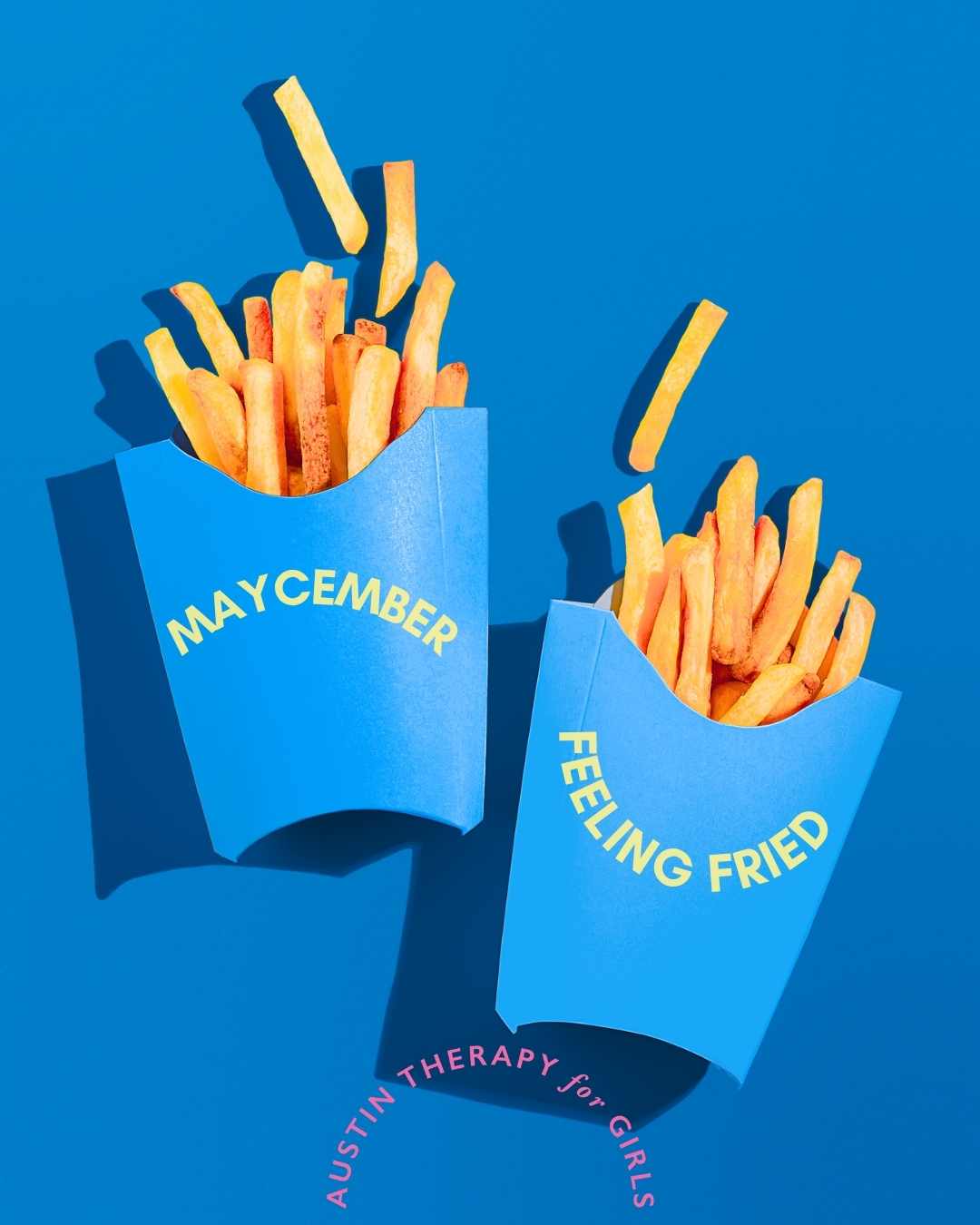
Maycember, Mental Load & the Sneaky Shame Gremlins
What Are Shame Gremlins, Why May Hits Girls So Hard
If April is quietly hard…
May kicks the door down.
Welcome to Maycember—that chaotic, end-of-school-year sprint where everything feels important, emotional, and just a little too much. Summer is so close… and somehow still feels so far away.
There are:
- Final exams
- End-of-year projects
- Friend drama (because of course)
- Dance recitals, banquets, graduations
- The looming pressure of swimsuits + summer bodies
- And the “I shoulds” are louder than ever (old therapist joke: don’t should on yourself)
For families—especially girls—May isn’t just busy.
It’s emotionally loud.
And that’s exactly when the shame gremlins love to show up.
What Are “Shame Gremlins”?
The term comes from Brené Brown, who describes shame as those internal voices that say:
- “You’re not enough.”
- “Everyone else has it together.”
- “You’re the only one struggling.”
For tween and teen girls, these thoughts don’t come out of nowhere—they get louder when stress is high and comparison is everywhere.
And in May?
It’s everywhere.
At Austin Therapy for Girls, we see this play out in real time.
In one of our recent Glow Girl Spring Reset groups, we did one of our favorite activities—the vulnerability mask. On one side, girls shared what they show the world: laughter, playlists, inside jokes, what they’re loving lately.
Then we turned to the other side—the parts they keep hidden.
The room got quiet.
Because underneath it all, so many girls landed in the same place:
“I don’t feel good enough.”
Which… hello, May.
Why May Hits Girls So Hard
By this point in the year, girls are:
- Mentally exhausted
- Socially stretched thin
- Hyper-aware of their bodies
- Feeling pressure to “end strong”
And here’s the part most people miss:
When girls are overwhelmed, they don’t just feel stressed—
they start to make it mean something about who they are.
“I’m falling behind.”
“I’m not as smart.”
“Something’s wrong with me.”
That’s not just stress.
That’s shame creeping in.
What Shame Looks Like in Girls
(Hint: It’s Not Always Obvious)
It doesn’t always look like tears.
Sometimes it looks like:
- Snapping at you over nothing
- Shutting down when you ask “What’s wrong?”
- Procrastinating or avoiding schoolwork
- Suddenly caring a lot about appearance
- Saying “I don’t care” (when they very much do)
Shame can be protective. It can be quiet. It can be sneaky.
But it’s there.
The Trap: Trying to Fix It Too Fast
When parents see their daughter struggling, the instinct is to:
- Problem-solve
- Reassure
- Minimize (“It’s almost over!”)
We get it—you want to help.
But here’s the truth:
You can’t logic a girl out of shame.
Shame heals in connection, not correction.
The Keys to Shame Resilience (What We Teach Girls in Session)
At Austin Therapy for Girls, we spend a lot of time helping girls build shame resilience—because shame isn’t something we eliminate, it’s something we learn how to navigate.
We often teach a simple framework based on the work of Brené Brown and her team—just translated into language that actually makes sense to tweens/teens:
1. Notice it
Start to recognize when shame is showing up.
That “ugh” feeling… the “I’m not enough” spiral… the urge to hide or shut down.
👉 That’s your cue: this might be shame.
2. Check the story
Ask yourself: Is this actually true… or is this my brain being really hard on me?
Shame loves to exaggerate and distort what’s real.
3. Don’t keep it all inside
Shame grows in silence.
Talking to someone you trust—a friend, parent, therapist—can take so much of its power away. As Brené states in the podcast, shame loses it’s power when spoken.
4. Say it out loud (Name the shame)
This is where we really start to take shame’s power away.
We actually teach girls to name it directly:
“I think I’m in shame right now.”
“This feels like a shame spiral.”
Because here’s the thing—we use a hurricane metaphor in session.
Just like storms, shame has levels.
Sometimes it’s a passing drizzle…
And sometimes it’s a full-on Category 5 shame storm.
And it’s incredibly helpful for the people in your life to know:
- How big the storm feels
- What you’re actually experiencing
Instead of shutting down or lashing out, girls learn to say:
“This feels like a Cat 5 right now—I’m overwhelmed.”
That kind of honesty creates connection instead of confusion.
A Quick Reframe for Girls
When those shame gremlins start talking, help her pause and ask:
“Is this true… or is this your shame gremlin talking?”
That one question can create just enough space to shift the spiral.
Want to Go Deeper?
If this topic resonates, there’s a powerful conversation on shame from Brené Brown and Adam Grant that many parents find helpful.
🎧 Listen here: The Emotion Few Talk About, But Many Feel
It’s a thoughtful deep dive—but start here, in real life, with connection and conversation at home.
The Bigger Picture
Maycember ends.
It always does.
But how girls feel about themselves during it?
That sticks.
This is a moment to help your daughter learn:
- Stress doesn’t define her
- Comparison isn’t truth
- Hard seasons don’t mean something is wrong with her
Final Thought (From Us to You 🤍)
If your daughter feels more emotional, more reactive, or more overwhelmed right now…
She’s not “being dramatic.”
She’s not “too much.”
She’s in May.
And May is a lot.
And you don’t have to navigate it alone.
We’re Here For You
If your daughter is feeling the weight of Maycember, we’re here to help her make sense of it—without shame.
👉 Schedule an initial appointment with one of our therapists at Austin Therapy for Girls
👉 Or check out our summer groups—because sometimes girls just need a space where they can exhale